


***UPDATE FEBRUARY 02, 2017***
Now there have been multiple comments on this review stating that there has been a drop in quality with these Sabrent USB External Stereo Sound Adapter. There have been reports of distorted sounds when using the microphone. While I do stand by my original review, I felt it was right to add these new findings, since this review is rated as the top comment and will most likely be seen by future customers.
***ORIGINAL OCTOBER 25, 2015***
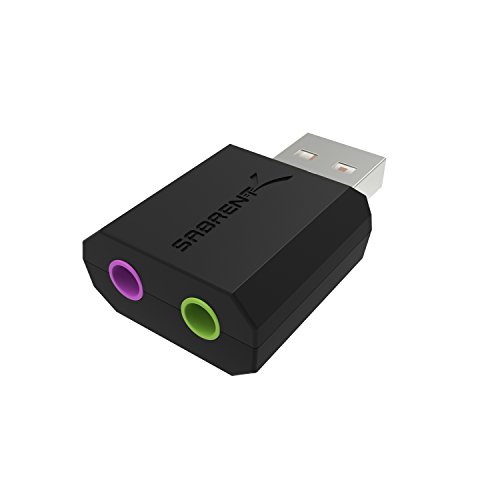
I had a damaged microphone port on my computer, so unfortunately, Neewer® 2X 3.5mm Hands Free Computer Clip on Mini Lapel Microphone (2X Lapel Microphone) that I had bought wasn't working. I had bought that cheapo mic because I had so many complaints about my built-in mic being grainy and unpleasant to listen to. So I got the new mic, and it didn't work on my computer. I even tested the mic on other computers, which it worked perfectly. Eventually I came to the conclusion that the microphone jack must of been damaged and the the signal wasn't going through. I bought this guy for like $6, plugged it in, and now it works flawlessly. For those who are curious, yes, you can set your speakers to still use your built in sound system, and not use the USB. Just go into Windows Sound settings and change it. In the Playback tab, make your built in speakers the default, and then go to the Recording tab and then make the USB the default for the microphone. I attached pictures so you know what it looks like. USB audio is the Sabrent. Now I did test the audio capacity too, just to see how it was, and it sounds find. You can plug your headphones into the green port. I attached some pictures to give an idea of size, and how I use it. Here is my recommendation. The thing is bulky compared to most USB devices, which given the fact that it is doing it's own processing makes sense. Try to make sure you have the set-up to where it doesn't get yanked. I can see that being bad. I received it October 17, 2015. If it breaks or anything like that, I'll try to remember to update this review of when it happened, how rough I was being on it, etc. As of right now, this is a stationary computer with a mic that I never take off the desk, so I can't imagine it getting damaged anytime soon. Green = headphone jack. Pink = Microphone Jack.
Uses C Media HS100B, crystal free, so sampling rate may not be synced with other cards. Housing is pretty strong. Latency test show this chip is very fast, only 10 mS.
Works as a charm! There was quite cranky built-in audio output and finally it stopped working. I have bought this adapter and all worries are gone.
For Mac users:
System Preferences > Sound > USB Audio Device
It was plug and play for Linux Mint 18.1, and almost certainly previous versions. I laugh when I consider how much time I spent trying to make the Realtek audio work on my motherboard. All I needed was $6.99 to get this dongle.
I use "pulse audio" so scripting the volume from a command file is accomplished this way:
$ pactl set-sink-volume 9 -5% # lowers volume by 5%, also accepts +10%, 20db, 50%, or multiplier e.g. 1.1 .
The 9 was obtained by typing "pactl list" and searching for "USB Audio Device". In my case, it was listed as "Sink #9".
The audio quality is "good", but you may find better. Some of the reviews also complain about low microphone input. Haven't tried. Perfect for me.
My headphone jack on my laptop broke, so I purchased this as a replacement. It works well, though you need to make sure your USB is plugged all the way in, as well as your headphones otherwise you'll be left with no audio. I feel like the jack on this USB is a little loose, because my headphones come out every now and then. Other than that though, I don't feel its changed the quality of the audio. Still loud and good as ever. It's easy to use too, you just plug it into your laptop and you're good to go. One thing I'll mention is the microphone. This has a mic jack, and it interferes with your built-in mic. I don't have an external mic, so I found it irritating that the USB took over my mic even though nothing was plugged in. There's a fix to that, though! On windows, right-click the speaker icon and click recording devices. Right click your laptop's mic, click "set as default device" and again as "set as default communication device" and it's fixed. I have to do this every time I power on my laptop and it's annoying, but only necessary to do if you skype or record often using your laptop's microphone.

Feature Product
- Connectors: USB Type-A, Stereo output jack, mono Microphone-Input jack.
- Driverless for Windows 98SE/ME/2000/XP/server 2003/Vista/7/8/Linux/Mac OSX.
- USB bus-powered, no external power required.
- Reverse compliant with USB Audio device class Specification 1.0
Description
Description: This Sabrient AU-MMSA 2.1 audio sound card adapter is a highly flexible audio interface, which can be used with either laptop or desktop system. No driver required, plug-and-play for instant audio playing and compliant with all mainstream operation systems. Simply plug the sound adapter into your USB port, and then plug your headphones into the adapter. Features no external power required. system requirements mac OS 8.6 or above what's in the box? information: 1 Year limited . When you register your new Sabrient product online within 90 days of purchase, your standard 1-year coverage is extended to 2-years.
Even though my Mac(s) have no problem with their built-in sound processing hardware, I picked up one of these strictly to use with the programs that I use to process audio signals for my amateur (“Ham”) radios as a simple solution to prevent inadvertently broadcasting something I don’t want going into the air like iMessage pings, new email bongs, and my iTunes. Works great. I configured my radio programs to use this usb dongle for handling audio, while everything else goes to the native built-in audio. Now I no longer have to worry about accidently becoming a music radio broadcasting station...!
That’s for “digital” modes like APRS/PSK31, SSTV. For analog voice modes such as for an EchoLink node, look elsewhere. It’ll work, but it’s very tinny.
TL;DR (Too, Long; Didn't Read) Version
Bought to fix a broken audio port.
The good
- Cheap and simple alternative/fix for a broken audio port that would have cost a couple of hundred dollars to get fixed.
- Simple and easy to use. Just plug it in and your computer will automatically install the necessary driver (took less than 30 seconds).
- Sound quality is comparable to your regular audio port output.
- The connector uses USB Type-A; Stereo output jack and Mono microphone-input jack.
- No external power required.
- Driverless and compatible for Windows 98SE/10/ME/2000/XP/Server 2003/Vista/7/8/Linux/Mac OSX.
The bad
- Only compatible with computers with a USB port (that means Apple users with the new model laptop would need an adapter.
- It is quite bulky to plug-in and sticks out (like any adapter). Great for stationary uses or connected to a work station.
Is it worth it? Yes. It is cheap and an easy to use device to get your audio output from your computer.
Your Answers, Our Questions:
Do I need to have built-in sound card in my laptop to use this?
No. This USB jack is all the hardware/software you need.
Will this work with Windows 10?
Yes. it will work with Windows 98SE/10/ME/2000/XP/Server 2003/Vista/7/8/Linux/Mac OSX.
I should plug in the sabrent usb external stereo sound adapter into my computer and then my headphones right?
Yes. Allow the USB to install the necessary drivers first before you use the headphones.
Small, inexpensive, sounds OK, and it works! I record audio at Sunday morning church service. There was a bit of a buzz which is common when using a laptop's internal sound ports, so I bought this to isolate the problem. Still have a small background noise, but I was able to figure out it's coming from the mixer instead of the laptop. This was plug 'n play with no additional drivers necessary on Windows 10. Just works!
I'm not an audiophile, but this seems to produce decent audio quality both on the input and output.
Pro tip: Windows lets you name your audio devices. This one is now named "USB Thingy"
-Sound settings
-Select input, hit [Properties]
-Rename in the box at the top then hit [OK]
I bought this for my Mac because I wanted to record and be able to listen to monitor headphones at the same time, and this worked great. Having two jacks instead of the standard Apple single jack was really nice.
So I got a little Lenovo for running a music program at meets, Took it to a meet and hooked it up, and nothing happened. Doh! Luckily I threw this in the bag. Hooked it up and it worked perfectly. I did need internet access for the PC to recognize the adapter, but once I got that and restarted, all was good. I suddenly had sound on the PC. I switched back and forth between the MacBook and the PC at the meet over four days and didn’t once have a problem. Sound at the meet was great.
As noted on another review, it is a little big, so I plugged it into a usb hub when I needed to. No issues there. It really is a great tool that gives you value for the price. In light of what I needed, I might buy another so I can have one at the desk in the house and one in the bag if I travel. For me, this was money well spent.
I bought this adapter because my Windows 10 laptop couldn't seem to understand a microphone plugged into the combination mic+headset plug. I've found simple PC adapters are often too cheap to work properly - not in this case: it works great!
Pluses: Nicely fixes the problem of not having separate mic and speaker plugs on my laptop. Nice quality audio for playing audio, making video calls, and recording screen sessions (I have a professional recorder for making CD-quality recordings).
Minus: It took a little fiddling around with Windows Playback Devices, Recording Devices, and Audio Setup dialogs to get it to work - but that seems to be Windows' fault, not this device's fault. The most puzzling was that I had to set up the Speech Recognition before I could simply record audio from this new device - again, I blame Windows 10.
Overall it's perfect for me.

0 comments:
Post a Comment