


Good PSU.
I decided to open this Evga 450BT and check is circuited, I was surprised by what I found.
The unit uses common forward topology (check this out in order to understand this review better).
Starting on the mains, the unit has a Ceramic fuse right behind the power switch, I can't read its rating, but hey nice to see a ceramic fuse instead of a glass one. Altough it is very badly placed and can't be replaced easily, you will need to desolder the smaller board behind the power switch in order to change the fuse.
Moving on we have 4 Class X2 caps and 7 class Y caps, a bit overkill, we also have 2 common mode inductors at the input, this is for EMI suppression, we also have a varistor after the fuse, (can't read its rating as it is inside a heatshrink, although it is very likely 275V AC), what this does it that if the mains voltage gets too high, the varistor shorts the mains and opens the fuse,
Now we get to the main bridge rectifier, it has no printing on front, this is really odd (it might be facing the heatsink), however it isn't much to worry about, the high voltage side of these PSU's operates with low currents.
After the rectifier we have a 0.47uF polypropylene cap (again more EMI protection), along with the main filter cap, which is a 400V 270 uF teapo cap rated for 105 degrees, the main cap comes after a relay and a thermisistor, the thermisistor is there in order to reduce the high start current of the main capacitor, there's also a huge inductor used for the active PFC.
The main switching transistors and the PFC transistor are 5R280CE, these are also with the bridge rectifier heatsink and are rated for 11 Amps are 100 degree centigrade,
The secondary uses two S30M60C in parallel for the 12V, each are rated for 30A at 100 degrees (giving 60A total at 100 degrees), again more overkill for a unit rated at 35A for 12V. All secondary caps are also teapo 105 degrees.
12V: The previously mentioned diodes -> Common mode inductor (shared with 5V) -> 2200 uF capacitor -> Another inductor -> 1000 uF capacitor.
5V: One S30M45C -> 1500 uF cap -> Inductor -> 1500 uF cap.
3.3V: Mag amp -> One S30M45C -> 3300 uF cap -> Inductor -> 1500 uF cap.
-12V: An SMD diode under the PCB (Can't read the model) -> 220 uF cap -> Inductor -> 330 uF cap.
5VSB: One S30M60C -> Inductor -> 1500 uF cap.
So almost all rails have their own pi filter. This is essential to keep ripple as low as possible.
The controller chips are a FAN4800C and a EM8564A, on the secondary we have a GR8323.
The output wires are all black, 18 gauge and rated for 80 degrees.
Overall the unit is very good ans should be perfectly capable of delivering its rated wattage, and even a bit more depending of how the over current protection is tweaked. The level of overkill of this unit is something you would expect of a unit worth several times the value of this one.
Edit: The main bridge rectifier is a GBU806 (had to remove the heatsink), nice.
Edit2: The varistor is a 10D561K, not the right part for this, it's clamping voltage is well beyond of what the GBU806 can take. They should have used a 10D431K instead.
Edit3: I had one unit die. Almost all diodes at the secondary failed short, and there was damage to the relay circuit at the primary side. Really odd.
Edit4: Fixed it. I still don't know what caused the diodes to die, I suspect that since this unit lacks OTP, was in a really hot place (ambient temp gets as high as 37 degrees centigrade very often here) with not much airflow for its fan, was running a PC with one RX480 and one GTX1060 mining 24/7, and that the unit controls the fan speed (likely uses the voltage drop across the shunts as reference for the fan speed). The diodes likely degraded because they were too hot and the fan was not maxed out.
I also had replace a transistor at the primary side that turns the unit on, Apparently the unit suffers a hysteresis issue, when it failed I could hear the relay switching rapidly. The transistor is an NPN one with a Y1 mark on top of it. The transistor had a 16V zener diode next to it that also failed.
Edit5: There's an NTC next to the secondary heatsink (was hidden by some black glue) that controls de fan speed, and it isn't working, I hit it wit the soldering iron and the fan speed doesn't change in the sightless. That explains it all, that fan always ran at minimum speed.
First of all and very important to me (as not to fry my MOBO and components): Great response -timely and helpful by phone and email, from EVGA tech support to my pre-installation, MOBO specific questions.
Easy to install. A lot less cable clutter inside the case (Thanks to modular cables). I like the fact that it came with a PSU testing tool - simple bridged 24 pin male connector, emulating that on the MOBO that you plug onto the corresponding ATX (20 + 4) pin cable and test the PSU before installing it. It is a simple test: the fan in the PSU either starts or doesn't when, connected to the AC power outlet, the PSU switch is set to ON. Mine was good. Its already installed and works perfectly.
I'm taking out a star because even though the packaging came undamaged and in perfect outside condition, one of the prongs on the power cable plug arrived bent (see pictures). Without damage on the packaging it means that the cable wasn't properly checked during package assembly at factory. However It took a set of pliers and a careful - gentle twist to set it straight again and, as explained, pre-installation test showed a working product. So, no big deal, but a call to attention at quality control during packaging. It is said that "the devil is in the details".
I haven't had any issues running this in my photo-editing rig. It came with much of what I needed. The three cables that are not modular, you need. One for the graphics card and two for the motherboard. The only cable I needed to add was for the SATA that I'm using for the SSD and the BDR. They included one SATA data cable. I used it for the BDR and ordered an extra 6.0 Gbps SATA III cable for the SSD. This fit fine in my case pointed down, which is preferred. This is my first EVGA power supply. I have heard of their great customer service. I hope I never have to use it. This rig is protected with a APC Battery Back-UPS, 1350VA (BN1350G) and a surge protector.
AMD Ryzen 5 1600 Processor with Wraith Spire Cooler (YD1600BBAEBOX)
ARCTIC ORACO-MX40001-BL MX-4 Thermal Compound Paste - 4 Grams
ASUS Prime B350-Plus AMD Ryzen AM4 DDR4 HDMI DVI VGA M.2 USB 3.1 ATX B350 Motherboard
Corsair Vengeance LPX 16GB (2x8GB) DDR4 DRAM
Corsair Carbide Series SPEC-02 Mid Tower Gaming Case
EVGA 750 BQ, 80+ BRONZE 750W, Semi Modular, 5 Year Warranty Power Supply 110-BQ-0750-V1
Corsair Air Series AF120 LED Quiet Edition High Airflow Fan Twin Pack - Red
JBtek All Red Sleeved PWM Fan Splitter Cable 1 to 2 Converter, 2 Pack
GIGABYTE GeForce GTX 1050 Ti DirectX 12 GV-N105TWF2OC-4GD 4GB 128-Bit GDDR5 PCI Express 3.0
Samsung 850 EVO 500GB 2.5-Inch SATA III Internal SSD (MZ-75E500B/AM)
LG WH16NS40 Super Multi Blue Internal SATA 16x Blu-ray Disc Rewriter
LG - 24" IPS LED FHD FreeSync Monitor
Monoprice 18-Inch SATA III 6.0 Gbps Cable
Cable Matters 3-Pack Gold Plated High Speed
I recently purchased this PSU to replace the one in a cyberpowerpc that I recently purchased as well. The reason I replaced the power supply, even though it was brand new (used for 1 day), is because of the multiple reports of very low quality PSU's used in some of their builds, and I couldn't find one single specification online for the one that came in the pc I purchased. EVGA has multiple 450 watt PSU's available but this one was $10 less than the next lowest priced 80+bronze PSU from EVGA. As far as I can tell, the only difference between this one and the others they have available is that this one is rated to produce a continuous 450 watts at 30 degrees Celsius (86 degrees Fahrenheit) while the others are rated at 40 degrees Celsius. The actual spec on this PSU is +30 but since it doesn't state how much above 30 degrees I'll just assume 30 even. I have this power supply running in a system with a core i5 7400 CPU, an AMD RX 580 4GB graphics card, 8GB of 2400mhz RAM, a 1TB 7200 rpm HDD, 4 case fans, a cpu fan, and 2 fans on the cooler for the graphics card. I stressed this setup with a few different benchmarks including Cinebench and Unigine's 3 benchmarks; Heaven, Valley and Superpostition, all on ultra settings. The GPU was running at %100 for almost the entire time the benchmarks were running and the fans (7 in all, not including the one built into the PSU) were also all running at %100. The EVGA 450 BT had no problems at all handling the power needs of my system under heavy load and stayed cool to the touch. It also features built in over voltage, over power, over current, under voltage, and short circuit protections. This means that if something were to happen to the PSU it should keep the rest of my system from harm, which gives me little more peace of mind. It also uses all black cables, a feature not often found on PSU's that cost $10 or even $20 more than this one. And while not modular, cable management was still pretty easy and, in my opinion anyway, looks pretty good in my case since it has a cover for the excess wires. The sleeve bearing used for the 120mm fan also keeps this unit running pretty quiet, which is nice. So unless your system's needs exceed the output of this power supply or you plan on using it outside in the middle of summer, I wouldn't have any worries making this purchase, especially since it comes with a 3 year warranty. And if you don't know how many watts you need in a power supply you can google "power supply calculator" and use one of the many free tools provided to give you a recommendation on the specs you need. I included some pics so you can see what the wiring looks like after installation. I'll also include a list of cable specs in case there is any confusion.
One 20+4 pin connector for the motherboard on its own cable.
One 8 pin (4+4 pin) connector for the CPU on its own cable.
Two 8 pin (6+2 pin) connectors for the GPU share the same cable with about 5 inches between the two connectors.
Four SATA connectors in total: Two SATA cables with two connectors each.
Three Molex connectors on one cable + 1 floppy cable
5 stars for value, warranty and peace of mind. EDIT: this PSU cost $30 with a $15 rebate at the time of my purchase.
Got this to replace a 10-year old 600W Rosewill power supply that finally gave up the ghost.
Overall, I'm pretty happy with this unit. It is functioning fine and solved some stability issues I was having (I'm guessing the old PSU was acting up in general before it completely went out). It's semi-modular, meaning that the cables for the motherboard and one video card are permanently attached, which is mostly fine as nearly everyone will need those.
It was a little disappointing in that they don't include cables for all the plugs: there are 2 PERIF plugs, 2 VGA, 1 CPU, and 2 SATA, however they only include 1 PERIF, 2 SATA, and 1 VGA cables. If you want to use the additional plugs you'll need to buy additional cables. That wasn't a problem for me as the included cables were sufficient for all of my devices (barely), but if you do end up buying additional cables be VERY careful as they're not universal between power supplies - often even within a manufacturer's own product line.
Other than that though, the unit is performing great, and it even includes a few nice to have "goodies" like a jumper to force the unit on for testing, screws, and velcro cable wraps.

Feature Product
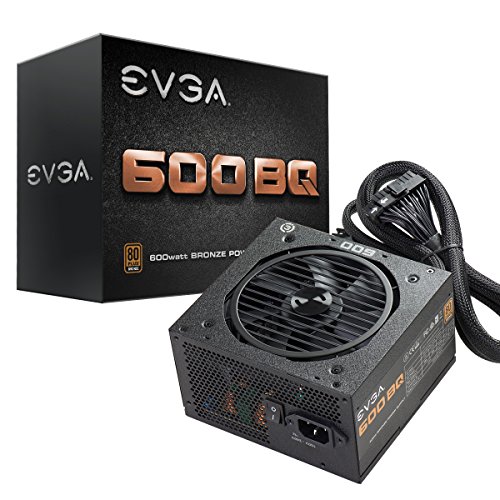
- EVGA 600 BQ - "Great Quality, Great Value"
- 80 PLUS Bronze certified, with 85% efficiency or higher under typical loads
- Fan Size / Bearing: 120mm Fluid Dynamic Bearing - Quiet and Intelligent Auto Fan for near-silent operation
- Heavy-duty protections, including OVP, UVP, OCP, OPP, and SCP
- AC Input 100 - 240 VAC, 10-5A, 50 - 60 Hz
Description
Introducing the next generation in value; the EVGA BQ Series. These power supplies take some of the best features from EVGA's award winning power supply lineup, like near silent operation and modular cables to make one of the best values today in high performance power supplies.
To give some background, my computer has been unstable since I built it. I suspected that it was the power supply due to fact that stability returned once I changed the power limit on my 1080 to 70 percent with lower clocks. Once this was done everything would run smoothly. With that in mind, I decided to see if replacing my power supply itself would allow me to run my hardware at what they were specced for. The previous power supply was a Rosewill Stallion 700 watt that I got as part of a package deal 2 months ago. In either case I ordered the 600 Watt b1 because of the reviews and my own experience with evga products. And this done didn't disappoint. I won't talk about installation because 1 power supply is no different then another if its not modular. What I will give praise for those is the cable length is perfect for a standard atx built with the cables being long enough to arrange fairly easily. It runs quiet which is great. And now I no longer have to down throttle my 1080 and my system ram is working at its specced speed and voltages. So in the future, if your computer crash's randomly etc. Try replacing the power supply after verifying the rest of your hardware is working as it should. This is the second time in my last 5 builds that the power supply was the culprit on my system. But to be fair 1 of them was a 4 year old psu out of warranty from another mfgr.
This power supply is by far the best one I have ever purchased, It is in my sons computer and he runs it in the ground with all of the game time he has, but it takes the punishment and keeps on going, it's a tough cookie. His computer has an expensive video card in it that requires a lot of power and he has lights inside of the case and with everything else running this power supply keeps on going , no problem . One last thing, it has all of the connections you will need to power up just about anything on the market today.
I have had many power supplies in the past. Some were horrible and some were fine. What you want is a power supply that just sits there and supplies power without drawing any attention to it. This fits that bill. It is a direct replacement for the identical power supply that after a few years of 24/7 use started to make noise when the fan bearing gave way. This replacement just fit right in. The holes all lined up. The connectors worked. The fan was quiet. Life was good.
I rarely give 5 stars as the items has to surpass my expectations. I was surprised that it all just fit perfectly. Murphy is almost always working overtime for me. The only draw back I have for this unit is the rather mediocre fan they used. A sticker held a rubber plug in place to keep the oil in the bearing. Over time, the sticker gave way, the plug got loose, and the oil drained. And hence the noisy fan. I took this opportunity to replace the fan in the old unit with a better quality fan and now have a spare ready for the next failure.
Writing this review in 2019, I just upgraded my daughter's old Haswell Pentium/GTX 750Ti build to a Core i5/GTX 1060 as she's doing a lot more than just browsing the web and Minecraft, so I upgraded her system... I also wanted to "add some bling" to her system, so I decided to get a new case and some custom cables for the PSU. She had an older no-name, uncertified PSU, and while I had no problems, I didn't want to trust her new upgrades with an old PSU of dubious history, plus I wanted full-modular for the cables I had in mind (I didn't have room for custom extensions, I needed to use custom replacements).
First off, there are MANY sites that offer wattage calculators for how much your system draws at peak useage... long story short, the average home computer with a single graphics card usually maxes out around 300W give or take. That doesn't mean buy a 300W PSU (don't do that!)... you never want your system to reach your PSU's max wattage, and the most efficient power draw a PSU ever reaches is usually around 50% max load... so if your system pulls around 300w, you want a PSU around 600w capacity for maximum efficiency. So unless you're running a ton of peripherals and two or more graphics cards, the average computer owner should be looking in the 550w-650w range... anything more is just throwing your money out the window and your PSU will be less effiicent since it won't even reach 50% of it's max draw.
I was very happy with this PSU... it's the perfect wattage, it runs very quiet, it has an econo-mode, it's small, its fully modular, and the cables that come with the PSU are all black wires from beginning to end... not a single "ketchup and mustard" wire to be found with this PSU. Also, becuase it is fully modular, it makes it easy to get replacement cables for custom wiring jobs as-in my pictures. I purchased the Cablemods E-Series replacement cables for her B3 PSU and was very happy with the results.
I've been using (and/or upgrading to) multiple EVGA PSUs for the many systems I have in my house and have never had one fail on me... I might replace one from time to time for various reasons, but it's never been becasue of a failure. EVGA has me as a happy return customer! You'd be wise to get one of their PSUs.
I've owned this PSU for a while now. It was apart of my old system and transferred to my new one. My old system had a motherboard issue and was a headache to figure out. I bought this PSU to make sure my old system didn't have a power issue. In the end it was time to build a new system, so I bought new motherboard, cpu and ram. Issues are gone now.
The plug and play factor is that it worked flawlessly. The fan is barely noticeable compared to my case fans. You would have to look at the fan to see that it's spinning to know that it is working. At the time of purchase the price was good for the watt rating and the 80+ Bronze efficiency. I can overclock on my new system without worrying about power delivery.
The only thing I have to worry about is if I wanted to run Crossfire or SLI. I have to make sure the gpu cards I choose and total system power draw all fit within the 500w limit or I'll have to upgrade. Other then that I should be good
This doesn't RGB lights or anything, so if your hoping for that look at a different one. It's more like a stealth look, all blacked out. You might forget it's there if you have an all black case and remove the decals.
Only con is that it's not a 80+ titanium. Just kidding lol
0 comments:
Post a Comment